Where does Personal Responsibility in Dog Guardianship Start?
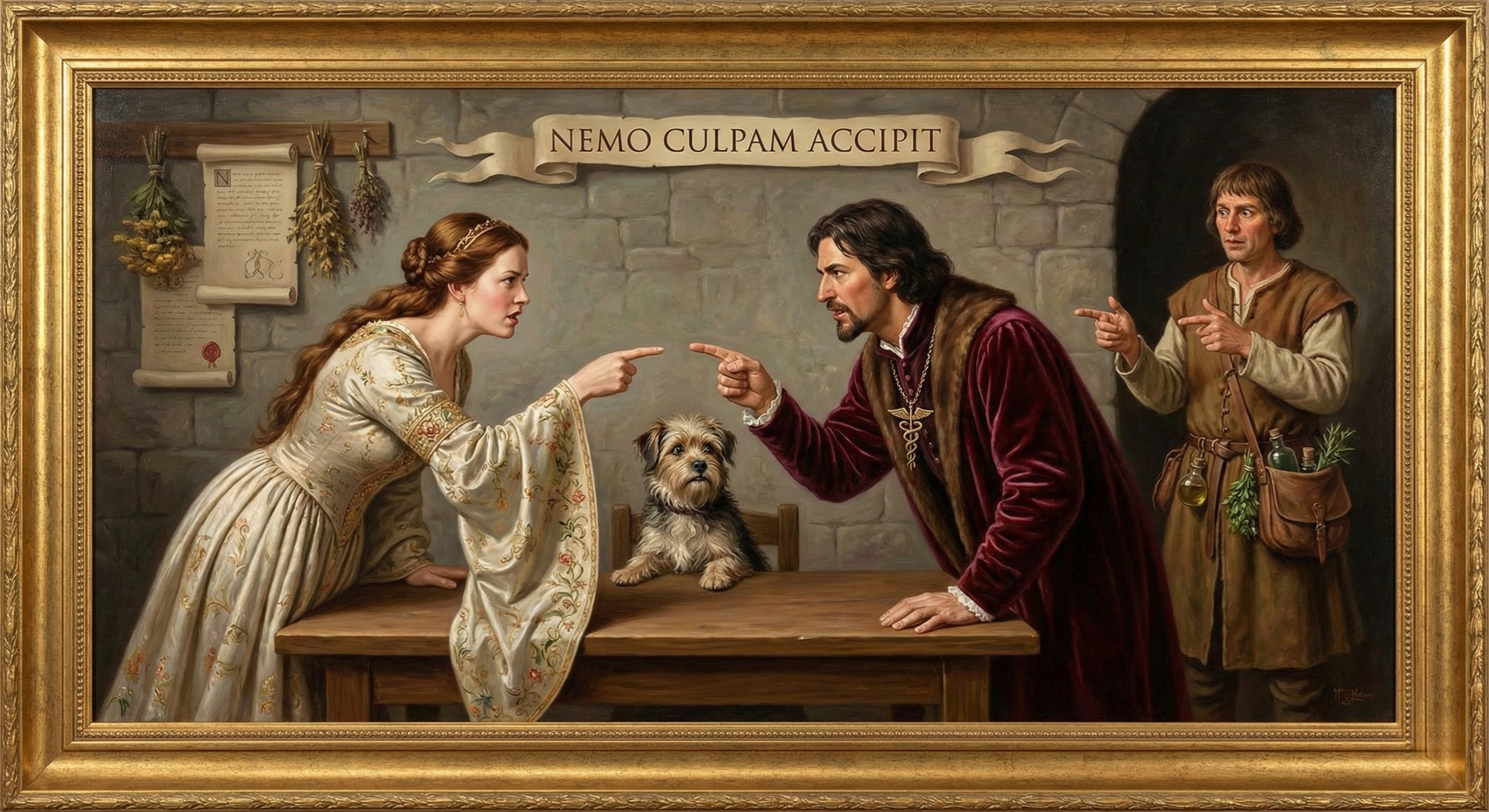
Nemo culpam accipit - No one takes the blame
“Managing client compliance is the secret to a high-performing and profitable practice.” ¹
How does that sentence make you feel? Like a valued part of your dog’s health journey?
The quoted sentence, which loosely translates to, ‘The more clients do what you say, the more products you can sell them’, stems from the introduction of a veterinarian’s article, or better, a transcribed version of his lecture called, ‘Yes, please: improving client compliance.’ This lecture was part of a 2019 British Small Animal Association congress.
Admittedly, more than a short one-page preview was not available for review publicly, but given this sentence’s central part in the introduction and no mention of ‘improving the dog’s health outcomes’, it seems feasible to assume the article does not focus on the relationship between client compliance (meaning the dog guardian’s adherence to the veterinarian’s treatment plan) and the dog’s health outcomes. From what we could gather, the article focuses heavily on how to get a client to return. Over and over.
If you have ever been part of a holistic veterinary health forum, you have encountered what many call ‘vet bashing.’ One of the biggest criticisms of conventional veterinary medicine, in such heated criticisms, is that veterinarians are not interested in your dog’s health and, therefore, are solely out there to make money.
If you, on the other hand, have ever followed a conventional veterinarian on social media, commenting on more natural modalities of animal care, you might have seen them employ ‘natural medicine bashing’ just as much as the other side likes to air their disdain for them. Natural medicine, according to them, is largely engaging in pseudoscience and a faulty understanding or misrepresentation of conventional veterinary medicine. As a result, natural medicine, as a sector of the pet health space, is endangering your dog’s wellbeing by selling you snake oil.
What does all that have to do with personal responsibility, you ask? Everything. Your dog’s health relies on the realization that you have to get involved, and that involvement does not begin at outsourcing your personal responsibility by blaming others for the state of the canine health industry, and by proxy, your dog’s health. Your dog’s health is your personal responsibility.
Where to start? Your first job is to recognize that canine health, conventional, holistic, and anything in between, is a business. This is reality, whether we like that reality or not. No one can live on love and air alone. The sooner you realize this fact, the sooner you can start asking critical questions. For starters, you might ask: Is the problem that someone is trying to sell me something? Or is the problem what, how, and why they sell it to me?
This concept also applies to us. Wolfried is a business. We make money from being a private canine consulting practice. However, instead of wanting you to follow through with our suggestions to endlessly increase what we can sell to you, we want you to improve your dog guardianship to the point where you don’t need us anymore-ideally, ever. Admittedly, depending on where you fall on this journey, we may suggest a few different services we offer, and we are not cheap. But our intention is not to make you dependent on us. It’s nothing personal. As much as we care for your dog, our goal is not an endless relationship. Our goal is your autonomy.
Part of our goal to empower you is to improve your critical thinking skills. We want you to learn how to ask questions that lead to better decisions for your dog. You are not a dog owner; you are their guardian. Guardianship comes with personal responsibility, not finger-pointing.
As you will learn, identifying a problem, dissecting the problem, maybe even sometimes with a bit of humor or sarcasm, is usually only fruitful if the goal is to find and implement a solution. Finger-pointing and just ranting might feel good in the moment, but part of why we see the state of canine health also involves us, the consumer. Yes, as dog guardians of five dogs, we are consumers, just like you. You might feel uncomfortable with this ‘we’re part of the problem’ bit, but there are many issues, internal and external, we face that prompt responses from veterinarians, the pharma-food industry, and the natural medicine complex.
One of our main responsibilities as a consulting practice is to feed your dog, not dogma. How do we achieve this feat? By engaging in a loop of listening, identifying, dissecting, asking questions, processing, learning, applying, watching for feedback, asking more questions, and learning again, all while trying our best to minimize our biases. Your personal responsibility is the same. The only difference is that we stay up to date on research and the canine health industry, break it down for you, and integrate the information to help you on the way.
But everything starts with a first step, and the first step, after you may have begun to ponder that nothing in this world, excuse our philosophical excursus, is truly for free, is recognizing that you can only control yourself. Within that control lies applying yourself to your guardianship. How well you can apply yourself falls squarely on how well you execute the aforementioned loop of your responsibilities, all while trying your best to minimize your biases.
Sounds like work? It is. Health is work. Trust us, we’ll chew on that part of reality more than once in this process.
References
1 Robinson, A. (2019). Yes, please: Improving client compliance. In BSAVA Congress Proceedings 2019 (pp. 313–314). British Small Animal Veterinary Association. https://doi.org/10.22233/9781910443699.40.7